

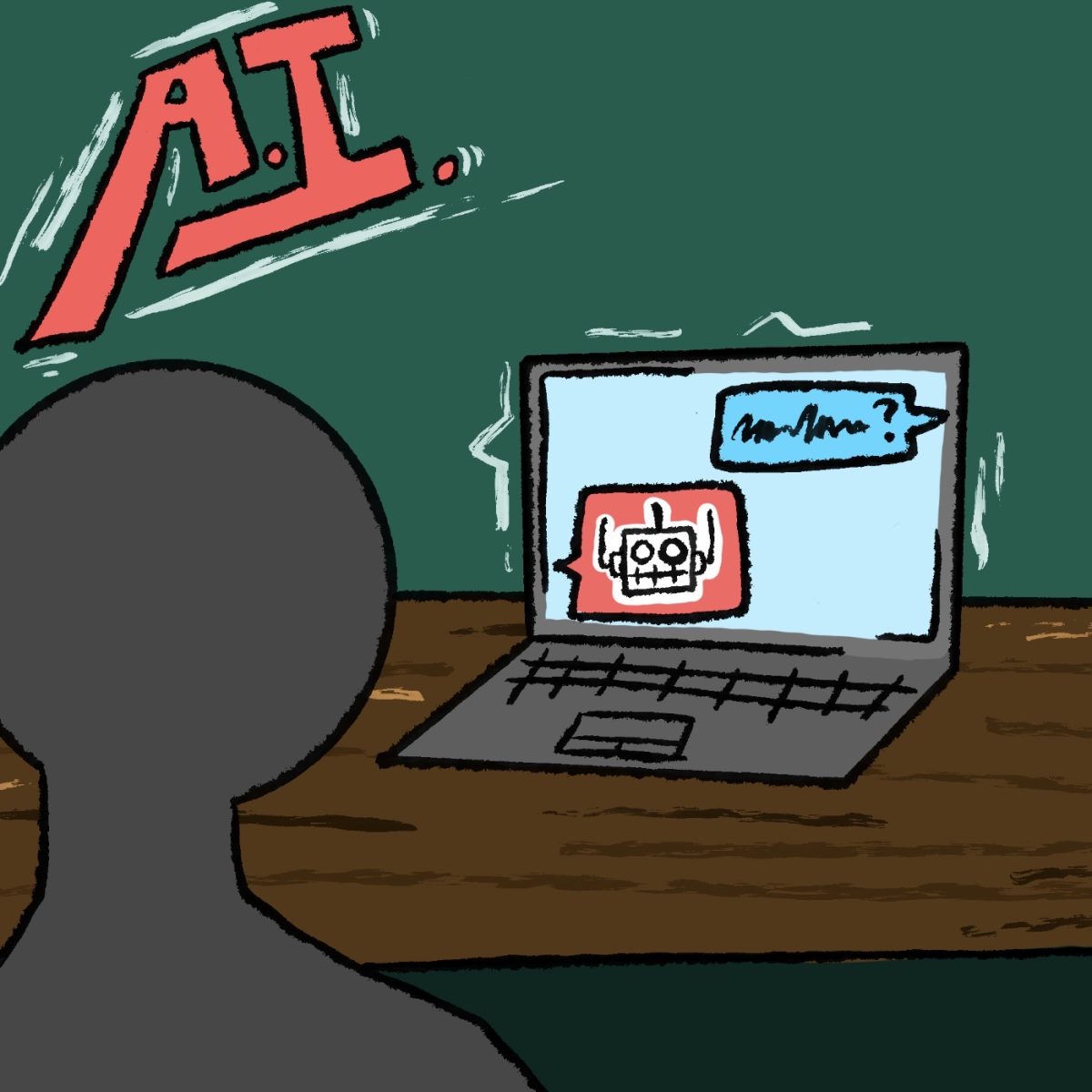
In 2025, 54 percent of students and 53 percent of English language arts, math, and science teachers reported using AI at school, according to www.rand.org. These numbers have increased by 15% over the last two years, driven by the widespread use of AI in school systems. Artificial intelligence is becoming an increasingly important factor in education, but is it actually helpful or harmful to students and educators? This debate is on a timely and complex matter, but each side has its pros and cons.
The use of AI in schools is helpful because it enables the creation of content tailored to each lesson topic or need, increases efficiency, and enhances student engagement. There’s such a wide range of subjects across every tier of school, from elementary to college. They each have their own different requirements and wants. There’s also an extensive range of students and learning types for whom AI can create opportunities and provide ways to obtain information and learn. AI provides adaptive learning, feedback loops, and learning analytics. None of these limits the student’s ability and are there to give and help. It will help improve students’ experience and overall education. For example, visual learners prefer information presented in images or charts that help them picture what they need to learn. AI is there to provide those and help the learner. AI is known for increasing efficiency. It has become very common for the day-to-day person to go to AI to ask basic questions that used to be answered by Google, Wikipedia, or other informational sites. As AI produces answers in seconds, it is a matter of efficiency and time. Plus, they aren’t being there promptly, and the information is also incorrect. This can be helpful in situations where teachers need to create lesson plans for each day, for each subject, across different classes and students. Well, teachers already have a workload of Staff instructionals, teaching, grading, and everything else in their personal lives. AI provides quick, easy access to materials and ideas. Artificial intelligence has become a powerful tool for educators and also helps enhance their tasks and teaching, according to www.edweek.org. “AI is now embedded, so teachers don’t have to go looking for it.” This means while AI is increasing, it also allows teachers to focus more on instructional teaching. Students in school are very tech-savvy and familiar with technology. Knowing this, AI introduces learning that they are familiar with and interested in. This provides students with a gateway to improve their education in impactful, enjoyable ways.
The direction of AI being harmful in school environments can be explained by biases in AI algorithms, privacy and data concerns, and the development of technology dependency. It’s been discovered that AI has biases related to race, gender, socioeconomic status, and geographic location. These biases can affect the answers that AI gives you. For example, Chapman University states, “Stereotyping Bias: Occurs when AI systems reinforce harmful stereotypes. For example, a translation model that consistently associates the word ‘nurse’ with female pronouns and ‘doctor’ with male pronouns perpetuates gender bias. Similarly, an image-generation model that portrays engineers as predominantly male contributes to occupational stereotyping.” This exemplifies that, because AI is being used in schools and produces biased responses, it is developing and reinforcing incorrect stereotypes among students and educators. While types of technology are still being discovered and their privacy and data concerns are being learned about, there are still questions about who owns AI and who has access to it, and everything along the coding lines. This leaves a lot of room for unknown information that is being used in school systems. The rapid growth of AI is driven by convenience, which hooks users and makes AI seem like a reliable tool. It causes the current decline in critical thinking, as it is always there to provide solutions and guide learning and processes, which are essential parts of school. Because AI is so readily accessible to students, they are increasingly relying on it rather than their actual educators, according to www.edweek.org. “One of the negative consequences AI is having on students is that it is hurting their ability to develop meaningful relationships with teachers, the report finds. Half of the students agree that using AI in class makes them feel less connected to their teachers. A decrease in peer-to-peer connections as a result of AI use is also a concern for teachers (47%) and parents (50%), according to the report.” This shows that AI is becoming increasingly impactful in students’ day-to-day learning environments.
To conclude, the use of AI in schools is increasing, and the debate over whether it is helpful or harmful has its own factors. It is important to acknowledge both sides of the argument: AI can be beneficial for students’ learning, while it can also be detrimental in the long term. The use of AI in school is increasing and is punctual and elaborate.